

TL;DR — QUICK ANSWER
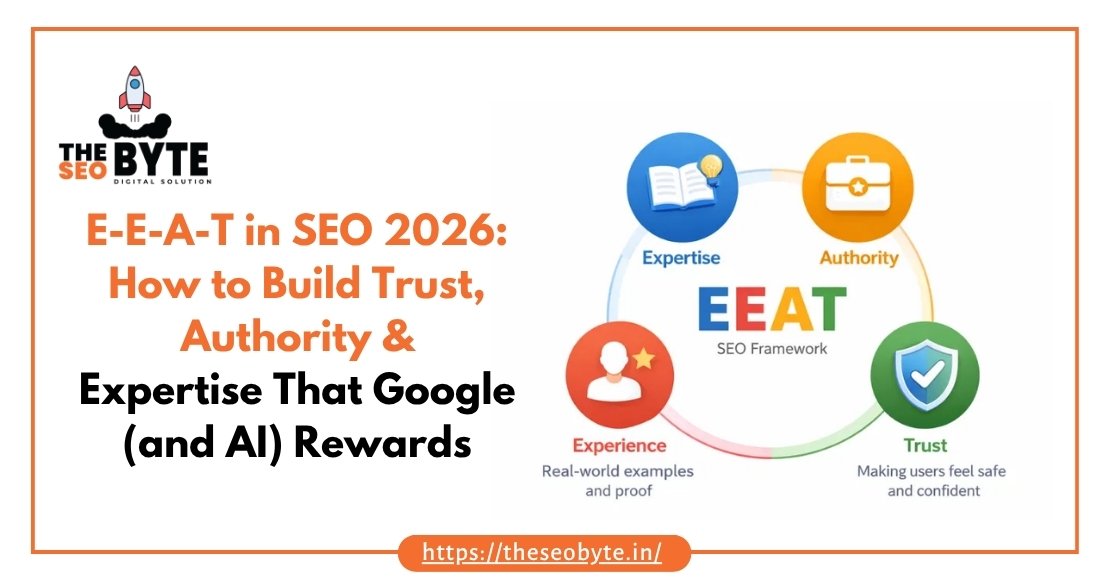
- E-E-A-T stands for Experience, Expertise, Authoritativeness, and Trustworthiness Google’s 4-pillar content quality framework
- E-E-A-T is NOT a direct ranking factor; it is a quality signal framework used by 16,000+ human quality raters globally
- Since March 2024’s Core Update, E-E-A-T signals directly influence AI Overview citation decisions not just organic rankings
- Pages with strong E-E-A-T signals earn 35% more clicks when cited inside Google AI Overviews (Seer Interactive, 2025)
- The 6-pillar implementation: author credentials → original research → brand entity → external mentions → schema → first-hand content
- E-E-A-T for local businesses (Agra, Delhi NCR, pan-India) requires GBP, local reviews, and LocalBusiness schema as priority signals
In 2022, Google updated its Search Quality Evaluator Guidelines and added a fourth letter to its foundational content quality framework. E-A-T—Expertise, Authoritativeness, Trustworthiness—became E-E-A-T with the addition of Experience. That one extra letter changed the entire conversation about what Google considers high-quality content.
In 2026, E-E-A-T in SEO is no longer a nice-to-have — it is the structural framework behind Google’s most consequential ranking and citation decisions. Every Google E-E-A-T signal now feeds directly into two systems simultaneously: traditional organic ranking and AI Overview citation eligibility. If your content doesn’t demonstrate experience, expertise, authority, and trust—to Google’s quality raters and to its AI systems—you are invisible in both.
At The SEO Byte, we’ve built E-E-A-T in SEO 2026 implementation into every client engagement since 2024. This guide gives you the complete picture: what is E-E-A-T in SEO, how each pillar is evaluated, the exact signals that move the needle, how to audit your current standing, and a practical implementation roadmap for businesses of every size from local brands in Agra to national e-commerce operations.
What Is E-E-A-T in SEO? The Complete Definition
What is E-E-A-T in SEO? E-E-A-T stands for Experience, Expertise, Authoritativeness, and Trustworthiness — the four-pillar framework Google’s quality raters use to evaluate the overall quality of web content. It is codified in Google’s Search Quality Evaluator Guidelines, a 170-page document that defines how 16,000+ contracted human evaluators assess content quality across the web.
According to the latest Search Quality Evaluator Guidelines, Trust remains the most important element of E-E-A-T and is used as a foundational quality assessment signal by Google’s quality raters.
A critical clarification before we go further: E-E-A-T is not a direct ranking algorithm or a score you can check in a dashboard. Google has been explicit on this point. What Google E-E-A-T does is inform the training and calibration of Google’s ranking systems—the quality rater feedback shapes how the algorithm weights signals over time. Think of it as the definition of quality that Google’s AI systems are trained to reward.
THE MOST IMPORTANT CLARIFICATION ABOUT E-E-A-T
There is no ‘E-E-A-T score’ you can measure in Google Search Console or any third-party tool. When tools claim to show your ‘E-E-A-T score,’ they are measuring proxy signals (domain authority, backlinks, author mentions) that correlate with strong E-E-A-T, not E-E-A-T itself. What you CAN measure: the individual signals that together create strong E-E-A-T author credential visibility, branded search volume, review sentiment, backlink quality, and content depth. These are the levers you optimize.
The Four Pillars of E-E-A-T—Defined
E—Experience—Does the Author Have First-Hand Knowledge?
Experience is the newest addition (added December 2022) and the most distinctive element of E-E-A-T in SEO. It asks, “Has the person who created this content personally experienced the topic?” A restaurant review written by someone who actually ate there. A product review written by someone who actually used it. A diabetes management guide written by a medical professional who treats patients. Firsthand experience is the signal most absent from AI-generated content, making it the primary differentiator Google uses to prefer human-authored, experience-driven content in 2026.
E—Expertise—Is the Author Qualified to Write on This Topic?
Expertise evaluates the depth of knowledge demonstrated in the content itself. For YMYL (Your Money Your Life) topics—medical, legal, financial, and safety—Google’s quality raters look for formal credentials. For non-YMYL topics, demonstrated knowledge through content depth can substitute for formal qualifications. Expertise is primarily evaluated at the content level — the quality of the explanation, the accuracy of the claims, and the depth of the coverage relative to what’s already available online.
A- Authoritativeness — Is the Source Recognised as an Authority?
Authoritativeness evaluates your reputation in your field — not as you define it, but as others reference and acknowledge it. This is the external validation layer of E-E-A-T Google: backlinks from credible industry sources, mentions in reputable publications, citations in academic or professional contexts, and recognition by established brands in your category. Authority cannot be claimed — it can only be earned through consistent expertise and external acknowledgment over time.
T—Trustworthiness—Can Users and Google Trust Your Site?
Trustworthiness is the foundation of the entire E-E-A-T in SEO 2026 framework Google’s Quality Evaluator Guidelines explicitly state that Trust is the most important of the four elements. Trustworthiness evaluates the following: Is the website safe? Is the content honest? Are claims accurate and supported? Is the business transparent about who it is and how it operates? Trust signals include HTTPS security, transparent authorship, clear contact information, accurate business information, genuine reviews, and absence of deceptive content.
Why E-E-A-T in SEO 2026 Matters More Than Ever Before
E-E-A-T in SEO 2026 has crossed a critical threshold: it now influences both organic ranking and AI Overview citations simultaneously. This dual-system relevance makes Google E-E-A-T the single most important quality framework for any serious content strategy this year.
Google’s Helpful Content framework reinforces this shift by rewarding content created primarily for people rather than search engines, making experience and expertise increasingly important ranking signals.
The AI Overviews Connection
Since the March 2024 Core Update and its subsequent refinements, Google’s AI systems have been calibrated to use E-E-A-T signals as citation confidence signals. Pages that demonstrate strong experience, expertise, authority, and trust are cited in Google AI Overviews at significantly higher rates than pages without these signals regardless of keyword optimization.
Seer Interactive’s November 2025 study found that pages cited in AI Overviews had measurably stronger E-E-A-T signals than uncited pages competing for the same queries, including named authorship, external link equity, and structured schema. This is the Google AI Overviews’ impact on SEO made concrete.
A large-scale academic analysis of more than 55,000 Google searches found that AI Overview source selection frequently differs from traditional organic rankings, suggesting authority and trust signals play a significant role in citation decisions. Strong E-E-A-T is now both a ranking factor and a citation factor.
The Core Update Pattern
Every major Google core update since 2022 has strengthened E-E-A-T ranking factor weighting. The August 2023 Core Update penalized sites with high traffic but thin expertise signals. The March 2024 Update deindexed millions of low-quality, experience-lacking pages. The December 2025 update extended E-E-A-T enforcement beyond YMYL into mainstream commercial categories including home services, education, e-commerce, and local business verticals affecting the majority of Indian business websites.
| Google Core Update | E-E-A-T Change | Impact Category |
| Dec 2022 | Added ‘experience’ (firsthand) to the framework. | All content types |
| Aug 2023 Update | Penalized shallow expertise, rewarded demonstrated knowledge | YMYL + mainstream |
| Mar 2024 Update | Deindexed low-quality pages; AI citation E-E-A-T calibration | All categories |
| Aug 2024 HCU Integration | Helpful Content integrated into core quality assessment | All content types |
| Jun 2025 Core Update | Topical authority + E-E-A-T as primary cluster ranking signal | Content clusters |
| Dec 2025 Update | E-E-A-T enforcement extended to local and commercial categories | Local business, Indian market |
How Google Evaluates E-E-A-T — The Quality Rater Process
To implement Google E-E-A-T effectively, you need to understand how it’s actually assessed. Google doesn’t run an automated E-E-A-T algorithm—it uses human quality raters whose aggregate assessments train the ranking systems. Understanding what raters look for gives you the clearest possible signal of what to build.
The Page Quality Rating Scale
Quality raters assign pages a rating from lowest to highest on a 5-point scale. The assessment combines E-E-A-T signals with purpose evaluation (does the page serve a legitimate purpose?) and main content quality. Here’s what moves a page from Medium to High to Highest:
| Quality Level | Primary E-E-A-T Signal | What Raters Look For |
| Lowest | Complete E-E-A-T absence | No author, no credentials, inaccurate claims, deceptive design |
| Low | Minimal signals | Thin content, vague authorship, generic information |
| Medium | Basic signals present | Named author, accurate content, some external validation |
| High | Strong signals across all 4 pillars | Credentialed author, depth, citations, clean trust signals |
| Highest | Outstanding, verifiable, externally validated | Expert author, original research, industry recognition, schema |
The Needs Met Rating — Where AI Overviews Come In
A second rating — Needs Met — evaluates how well a page satisfies the specific query. In the AI Overviews era, E-E-A-T in SEO intersects with Needs Met through Answer Engine Optimization: a page that both demonstrates strong E-E-A-T and satisfies the query in an answer-first format earns the highest combined Page Quality + Needs Met rating, making it the most likely citation source for AI Overviews.
How to Improve E-E-A-T: The 6-Pillar Implementation Framework
This is the actionable core of the guide. How to improve E-E-A-T is not a single tactic — it is a system of layered signals, each one reinforcing the others. The SEO Byte’s implementation framework organizes these signals into six pillars, ordered from highest-impact to longest-to-build:
Pillar 1: Build a Credentialed Author Profile System
Named authorship is the fastest, most controllable signal for E-E-A-T in SEO 2026. Industry research from Ahrefs highlights author transparency, verifiable credentials, and external professional presence as some of the strongest observable E-E-A-T indicators.
Every piece of content on your site should have a named author with a dedicated author bio page that includes:
- Professional credentials: Qualifications, certifications, years of experience, and areas of specialisation relevant to the content topic
- Verifiable identity: LinkedIn profile link, Google Scholar (for research-heavy authors), professional organisation memberships
- Publishing history: Links to other published work — guest articles, media mentions, speaking engagements
- First-hand context: A brief statement of direct experience—’I’ve managed SEO campaigns for 80+ Indian businesses since 2018′ carries significant weight as an experience signal
- Author schema markup: Person schema on the author bio page explicitly connecting the author entity to the content they’ve written
THE SPECIFIC SIGNALS THAT MATTER
Google’s quality raters are instructed to search for the author beyond your website. They look on LinkedIn, Google News, Wikipedia, and Google Search for corroborating evidence of expertise. If your author appears only on your own site with no external presence, the ‘authoritativeness’ signal is weak regardless of how well-written their bio is. Action: Every primary content author at The SEO Byte has a LinkedIn presence, at least 2 published pieces on external platforms, and a consistent name-to-expertise association across all platforms where they’re mentioned.
Pillar 2: Demonstrate First-Hand Experience in Content
The Experience pillar—the ‘E’ added to create E-E-A-T from E-A-T; Google added Experience to E-E-A-T in 2022—requires that content demonstrate firsthand, lived knowledge. This is the signal AI-generated content cannot authentically replicate, making experience-driven content SEO the most durable competitive advantage in 2026.
Specific techniques for demonstrating first-hand experience:
- Case study integration: Reference specific client results, named campaigns, or documented outcomes. ‘We increased a Lucknow-based clinic’s organic traffic by 280% in 6 months using this exact framework’ is experience. ‘Content strategy improves traffic’ is not.
- Personal perspective paragraphs: Insert first-person observations that could only come from direct experience: ‘In our work across 80+ Indian businesses, we’ve consistently found that…’
- Original data: Surveys, A/B test results, proprietary analytics insights, or before-and-after case data that exists nowhere else online
- Process documentation: Show your actual working method—screenshots of real tools, specific workflows, named team members’ contributions
Pillar 3: Build Your Brand Entity Across the Web
Brand entity building is the authoritativeness pillar in practice. Google E-E-A-T evaluates your brand’s authority partly by how consistently and credibly it appears across the web—not just on your own website. The goal is to make your brand a clearly defined, verifiable entity that AI systems and quality raters can confirm independently.
The Brand Entity Checklist:
☑ Google Business Profile: 100% complete, verified, with Q&A populated and reviews actively managed
☑ LinkedIn company page: Active, consistent with website brand description, linked from your website
☑ Wikipedia (where eligible): For larger brands—a Wikipedia presence is one of the strongest entity authority signals
☑ Press and media mentions: Even a single credible publication mention significantly strengthens the Authoritativeness signal
☑ Industry directory listings: Consistent NAP (Name, Address, Phone) across 50+ directories
☑ Review platform presence: Minimum 20 genuine reviews on Google, and presence on at least one category-specific platform (Clutch for agencies, Practo for healthcare, etc.)
☑ Podcast/webinar appearances: Audio and video content mentioning your brand or author builds entity breadth
Pillar 4: Implement Trust Signals Across Every Page
Trustworthiness—the most heavily weighted pillar in E-E-A-T Google‘s framework—is built at the page level and the site level simultaneously. A single untrustworthy element can undermine the trust signals of an otherwise authoritative page.
Page-level trust signals:
- Accurate, verifiable information: Every factual claim backed by a named, dated, linkable source
- Transparent author attribution: Named author with linked bio on every piece of content
- Clear publication and update dates: Users and quality raters both look for content recency signals
- No deceptive elements: No hidden sponsored content, no fake reviews, no misleading headlines
- Functional outbound links: Links to cited sources work and point to credible destinations
Site-level trust signals:
- HTTPS with valid SSL certificate: Non-negotiable baseline—HTTP sites fail the basic trust threshold
- Clear About page with team information: Who runs this website? What are their credentials? What is the company’s mission and history?
- Accessible contact information: Phone, email, and physical address visible on every page footer
- Privacy policy and terms of service: Required for YMYL categories, strongly recommended for all
- No malware or intrusive advertising: Google’s Safe Browsing flags immediately undermine all other trust signals
Pillar 5: Build Topical Authority Through Content Clusters
Individual pieces of strong content are necessary but not sufficient for high E-E-A-T in SEO 2026. Google evaluates topical authority — how comprehensively a website covers a subject area — as an authoritativeness signal that applies at the domain level, not just the page level. A single outstanding article on E-E-A-T signals less authority than a complete cluster of interlinked articles covering E-E-A-T from every angle.
This is the connection between E-E-A-T in SEO and the content cluster strategy we’ve built across The SEO Byte’s blog. Our AI search cluster—covering Answer Engine Optimization, AEO vs. SEO, Google AI Overviews, and AI Overviews’ impact on organic traffic—signals topical authority across the entire AI search category, not just any single post.
Pillar 6: Use Schema Markup to Make E-E-A-T Machine-Readable
Schema markup is the technical layer that converts your E-E-A-T signals from human-readable to machine-readable—allowing both Google’s crawlers and AI systems to extract and verify them with high confidence. Without schema, AI systems have to infer your E-E-A-T from contextual signals. With schema, you declare it explicitly.
Priority schema types for E-E-A-T implementation:
- Person schema: Author bio pages — connects author name, credentials, and published works into a verifiable entity
- Organization schema: Site-wide—declares our brand name, founding date, description, contact details, and logo as a machine-readable entity
- Article schema: Every blog post connects author, publication date, headline, and organisation as a structured content unit
- LocalBusiness schema: Location-specific pages essential for businesses in Agra, Delhi NCR, and across India targeting local search
- FAQPage schema: All FAQ sections signals Q&A content to AI extraction systems, increasing AI Overview citation probability by up to 60%
- Review / AggregateRating schema: Service and product pages makes your review data machine-readable and eligible for star rating rich results
Want Your E-E-A-T Signals Audited by Experts?
The SEO Byte offers free E-E-A-T audits for businesses across India—we assess all six pillars, identify your weakest signals, and deliver a prioritized fix plan within 48 hours.
>> contact@theseobyte.in | theseobyte.in | Agra, India <<
How to Conduct an E-E-A-T Audit: The 20-Point Checklist
An E-E-A-T audit systematically evaluates your site’s current signal strength across all four pillars. It doesn’t require specialist tools—it requires structured evaluation against Google’s own quality criteria. Use this 20-point checklist of Ahrefs E-E-A-T Audit Framework to assess your website trust signals and identify your priority improvement areas:
Experience Signals (5 Points)
☑ Does every article include first-person observations or case study references specific to the author’s direct experience?
☑ Is original data (surveys, test results, proprietary analytics) used anywhere in your content?
☑ Do author bios include statements of direct, verifiable experience relevant to the content topic?
☑ Does your content include screenshots, real examples, or documented workflows that prove hands-on knowledge?
☑ Is the writing style clearly differentiated from generic AI-generated summaries of the same topic?
Expertise Signals (5 Points)
☑ Does every page have a named author with a dedicated bio page containing credential information?
☑ Are all factual claims supported by named, dated, linkable external sources?
☑ Is the content depth meaningfully greater than competitor pages for the same query?
☑ Are technical terms used accurately and explained at the appropriate depth for the target audience?
☑ Is the Person schema implemented on author bio pages, linking the author’s name to credentials and published works?
Authoritativeness Signals (5 Points)
☑ Does your brand appear in at least one credible third-party publication, directory, or press outlet?
☑ Do you have a minimum of 20 genuine reviews on your Google Business Profile?
☑ Is your LinkedIn company page active and consistent with your website brand description?
☑ Do other websites in your industry or niche link to your content as a reference source?
☑ Is your brand’s core description consistent across your website, GBP, LinkedIn, and directory listings?
Trustworthiness Signals (5 Points)
☑ Is the entire site served over HTTPS with a valid SSL certificate?
☑ Is there an About page with specific information about the company, team, and expertise?
☑ Is contact information (phone, email, physical address) visible in the site footer?
☑ Are publication dates and last-updated dates visible on all blog content?
☑ Is the site free of deceptive elements—fake reviews, undisclosed sponsored content, and misleading headlines?
HOW TO SCORE YOUR E-E-A-T AUDIT
Count your checked items: 18–20 = Strong E-E-A-T foundation | 13–17 = Moderate priority improvements needed | 8–12 = Weak significant E-E-A-T gaps, high risk in core updates | Under 8 = Critical—at risk of quality penalties. Each unchecked item is a specific, actionable improvement. The SEO Byte’s E-E-A-T audit goes deeper than this 20-point framework, including backlink quality assessment, competitor E-E-A-T benchmarking, schema gap analysis, and a 90-day implementation roadmap.
E-E-A-T in SEO for Different Business Types
E-E-A-T for YMYL Businesses (Healthcare, Legal, Finance)
YMYL—Your Money Your Life—categories face the strictest Google E-E-A-T evaluation because poor-quality content in these areas has real-world consequences for users’ health, safety, or financial well-being. For healthcare clinics, legal firms, and financial advisors in India—including businesses in Agra, Lucknow, and Delhi NCR—E-E-A-T is not a recommendation: it is the minimum threshold for search visibility
YMYL E-E-A-T requirements:
- Formal credentials required: Medical content must be authored or reviewed by a licensed medical professional. Legal content by a qualified advocate. Financial content by a SEBI-registered advisor.
- Regulatory body mentions: Association memberships, council registrations, and professional certifications should be named explicitly and verifiably
- Peer review signals: For healthcare specifically, citations from medical journals, government health portals, or peer-reviewed sources dramatically strengthen E-E-A-T
E-E-A-T for Small and Local Businesses
A common misconception: E-E-A-T for local businesses is somehow different or easier than E-E-A-T for national brands. The principles are identical — only the scale and context differ. A best SEO company in Agra must demonstrate the same four pillars as a national agency—just through locally appropriate signals:
- Local press and community mentions: A mention in Dainik Jagran, Amar Ujala, or a local business chamber carries significant local authority weight
- Google Business Profile as a trust anchor: For local businesses, GBP is the primary trust and authority signal—a 4.5+ star rating with 50+ reviews is the meaningful threshold
- LocalBusiness + Service schema: Explicit schema on all location and service pages declares your business type, service area, and operating hours to AI systems
- Local case studies: ‘We helped a Sadar Bazaar retailer increase WhatsApp leads by 3× in 90 days’ is experience-driven content that only a local business can authentically publish
E-E-A-T for E-Commerce
E-commerce E-E-A-T signals are concentrated at the product and category page level rather than the blog level. Key priorities:
- User-generated content: Genuine customer reviews with photos and specific detail are the strongest experience signals for product pages
- Expert product descriptions: Descriptions that demonstrate genuine product knowledge rather than manufacturer copy
- Return and refund policy transparency: Clearly visible, specific, and customer-friendly — a core trustworthiness signal for commercial sites
- Seller verification: Third-party marketplace verification badges, industry association logos, and payment security signals
E-E-A-T in SEO 2026 and the AI Search Connection
The relationship between E-E-A-T in SEO 2026 and AI search visibility is the most strategically important development in this space. Google’s AI systems — powering Google AI Overviews — are calibrated against the same quality framework that human quality raters use. Strong E-E-A-T signals are therefore citation eligibility signals in AI search, not just ranking signals in traditional organic.
This creates a direct implementation hierarchy: build strong E-E-A-T first, and you simultaneously improve traditional organic rankings and AI Overview citation probability. This is why Answer Engine Optimization and AEO vs SEO strategy always begins with an E-E-A-T foundation—you cannot engineer AI citation on a weak trust and authority base.
| E-E-A-T Pillar | AI Search Signal | Google Ranking Signal | Implementation Priority |
| Experience | First-hand claims AI cannot replicate | Helpful Content alignment | Author bio + case studies: Week 1-2 |
| Expertise | Content depth AI systems prefer for citations. | Topical depth assessment | Content cluster + source citations: Month 1 |
| Authoritativeness | Brand entity validation for citation confidence | Domain authority input | Brand entity building: Month 1-3 |
| Trustworthiness | Citation confidence foundation (most weighted) | Core algorithm quality signal | Schema + HTTPS + About: Week 1 |
E-E-A-T for Businesses in Agra, Delhi NCR, and Across India
The December 2025 Core Update extended Google E-E-A-T enforcement into local and commercial categories across the Indian market, affecting service businesses, educational institutions, healthcare practices, and retail brands that had previously operated in a relatively lower-enforcement environment.
For businesses in Agra, the competitive landscape is shifting. Businesses that invest in E-E-A-T in SEO now — while local competitors are still running keyword-only strategies — will build a compounding authority advantage that becomes very difficult to displace. As a digital marketing agency in Agra working with local businesses since 2022, The SEO Byte has a clear view of this window: it is open now, and it will not stay open indefinitely.
The most impactful E-E-A-T signals for local businesses in the Indian market, in priority order:
- Google Business Profile optimisation: Complete, verified, actively reviewed the primary local trust anchor
- Hindi-language FAQ content with schema: Voice search and AI Overview coverage for regional language queries significantly underexploited in Agra and UP markets
- Local press and community citations: Regional news coverage, chamber of commerce membership, local award recognition
- Consistent NAP across 50+ Indian directories: Justdial, Sulekha, IndiaMart, TradeIndia, and category-specific platforms
- Client case studies in local context: Named, specific outcomes for named (with permission) Agra or Delhi NCR businesses
- AI SEO services in Agra: For agencies like The SEO Byte, demonstrating AI-era service capability is now part of the Expertise signal for a digital marketing brand
Build Your E-E-A-T Foundation With The SEO Byte
From author biosystems to schema markup to brand entity building, we implement the complete E-E-A-T framework for businesses across India. Free audit included.
>> contact@theseobyte.in | theseobyte.in | Agra, India <<
FAQs — People Also Ask About E-E-A-T in SEO
Q: What is E-E-A-T in SEO?
A: E-E-A-T in SEO stands for Experience, Expertise, Authoritativeness, and Trustworthiness. It is the four-pillar content quality framework described in Google’s Search Quality Evaluator Guidelines—used by 16,000+ human quality raters to assess web content. It is not a direct ranking algorithm or a score, but its signals directly influence how Google’s ranking systems and AI Overview citation systems evaluate content quality.
Q: Is E-E-A-T a direct Google ranking factor?
A: No — E-E-A-T is not a direct ranking factor in the sense of a specific algorithmic signal you can measure. Google has explicitly clarified this. What E-E-A-T does is inform the training of Google’s ranking systems through quality rater feedback. Strong E-E-A-T signals correlate very strongly with higher rankings because they reflect genuine content quality — not because there is a discrete E-E-A-T metric in the algorithm.
Q: What is the difference between E-A-T and E-E-A-T?
A: E-A-T (Expertise, Authoritativeness, Trustworthiness) was Google’s original framework. E-E-A-T added ‘Experience’ as the first E in December 2022. The addition of experience specifically addresses first-hand, lived knowledge—distinguishing content written by someone who has personally experienced the topic from content that aggregates secondhand information. This addition was widely interpreted as a direct response to the rise of AI-generated content.
Q: How do I improve my E-E-A-T score?
A: There is no single ‘E-E-A-T score’ to improve. What you improve are the individual signals across four pillars:
(1) Experience: add case studies, first-person observations, and original data.
(2) Expertise: Name authors with credentials, cite reputable sources, and deepen content coverage.
(3) Authoritativeness: Build brand mentions, earn backlinks from credible sources, and get press coverage.
(4) Trustworthiness: Implement HTTPS, publish clear About and Contact pages, manage reviews actively, and add organization and person schema.
Q: How does E-E-A-T affect Google AI overviews?
A: E-E-A-T signals directly influence AI overview citation decisions. Google’s AI systems use the same quality framework as human quality raters when determining which sources to cite in AI-generated answers. Pages with strong E-E-A-T signals—credentialed authors, original data, external brand mentions, and clean trust signals—are cited in AI Overviews at measurably higher rates than pages without these signals, regardless of keyword optimization.
Q: What is an E-E-A-T audit?
A: An E-E-A-T audit is a structured evaluation of your website’s current signal strength across all four E-E-A-T pillars—Experience, Expertise, Authoritativeness, and Trustworthiness. It typically includes author credential assessment, content depth benchmarking against competitors, brand entity review across third-party platforms, schema implementation gap analysis, backlink quality evaluation, and trust signal verification. The output is a prioritized list of improvements mapped to the specific E-E-A-T signals each fix addresses.
Q: Does E-E-A-T matter for small businesses and local businesses?
A: Yes — the December 2025 Core Update extended E-E-A-T enforcement into local and commercial categories, directly affecting small and local businesses. For local businesses in Agra, Delhi NCR, and across India, the most important E-E-A-T priorities are Google Business Profile completeness and review management (Trustworthiness), local press mentions (Authoritativeness), service-specific content written by named staff (Expertise), and client case studies with local context (Experience).
Q: What schema markup helps improve E-E-A-T signals?
A: Five schema types most directly support E-E-A-T signals:
(1) Person schema — connects author name, credentials, and published works into a verifiable entity.
(2) Organization schema — declares your brand as a structured entity with contact details and description.
(3) Article schema—connects content to its author and organization.
(4) LocalBusiness schema — critical for local E-E-A-T signals.
(5) FAQPage schema—increases AI Overview citation probability by making Q&A content machine-readable. All should be implemented in JSON-LD format.
Q: How long does it take to improve E-E-A-T?
A: Technical signals (HTTPS, schema markup, About pages and author bios can be implemented within 1–2 weeks and are crawled quickly. Content depth and experience signals improve over 1–3 months as new content is published and indexed. Authoritativeness signals—brand mentions, backlinks, and press coverage—are built over 3–12 months of consistent outreach and content promotion. Core update benefits from E-E-A-T improvements typically show in the first major update after implementation, which can be 3–6 months.
Q: Does The SEO Byte provide E-E-A-T optimization services?
A: Yes. The SEO Byte provides complete E-E-A-T implementation as part of our AI SEO services in Agra and across India—including E-E-A-T audits, author bio system setup, schema markup implementation (Person, Organization, Article, LocalBusiness, FAQ), brand entity building, content depth analysis, and topical authority cluster development. We work with businesses across Agra, Delhi NCR, Lucknow, and pan-India. Free E-E-A-T audit available at hello@theseobyte.in.
Conclusion: E-E-A-T Is Now the Foundation of Every Ranking System That Matters
E-E-A-T in SEO 2026 has evolved from a content quality guideline into the structural framework behind both Google’s ranking algorithm and its AI Overview citation system. The four pillars—Experience, Expertise, Authoritativeness, and Trustworthiness—are no longer evaluated in isolation; they form an integrated signal network that determines whether your content earns visibility in organic search and in AI-generated answers.
The businesses that understand Google E-E-A-T at this level—not as a checklist, but as a demonstration of genuine quality—are the ones building durable competitive advantages in 2026. Every core update penalizes content that lacks E-E-A-T signals. Every AI Overview citation favors content that has them. The window to build these signals before your competitors do is the most valuable strategic opportunity in Indian digital marketing right now.
At The SEO Byte—a digital marketing agency in Agra building AI-first SEO strategies for businesses across India—E-E-A-T in SEO is not a bolt-on service. It is the foundation of every engagement we run. If your content isn’t demonstrating experience, your authors aren’t credentialed, your brand entity is inconsistent, and your schema markup is missing, we’ll find it, fix it, and build the trust signals that make your content worthy of both Google’s algorithms and AI’s citations.

1 Comment