

Table of Contents
Imagine this: you’re spending ₹1,50,000 a month on Google Ads, your traffic numbers look healthy, but sales aren’t moving. The problem isn’t your budget. It isn’t even your targeting. The problem is that your website is leaking potential customers at every step — and you haven’t fixed the holes yet. That’s exactly what conversion rate optimization is designed to solve.
At The SEO Byte, we’ve worked with businesses across Agra, Delhi NCR, Lucknow, and beyond and one pattern repeats itself constantly: brands obsess over driving more traffic when optimizing what they already have would double their revenue. This guide covers everything you need to know about conversion rate optimization, from the foundational formula to the advanced tactics, the right conversion rate optimization tools, and how CRO digital marketing fits into your broader growth strategy in 2026.
1. What Is Conversion Rate Optimization?
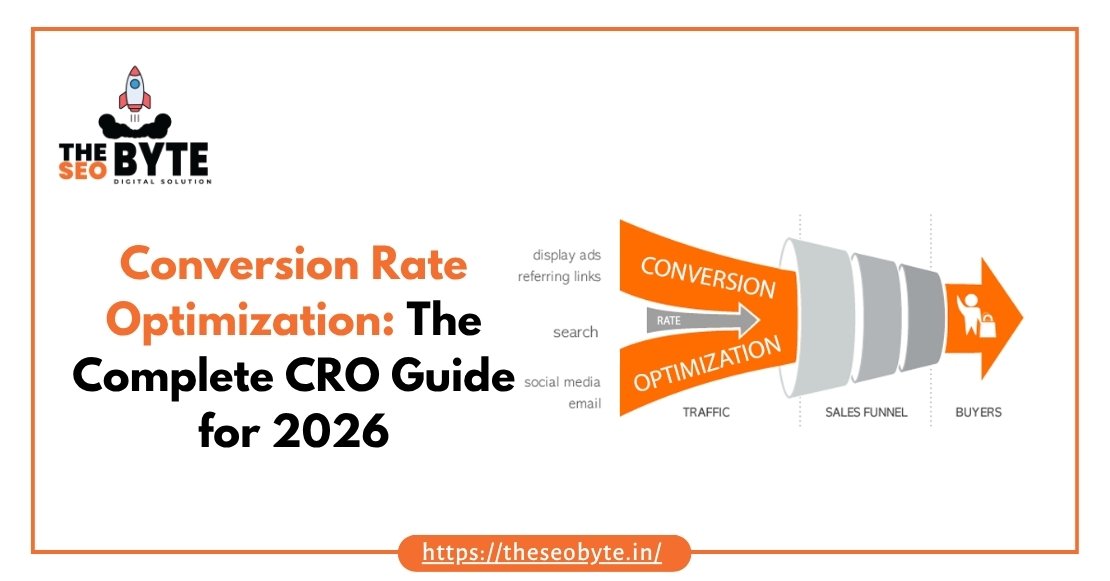
Let’s start with the basics. What is conversion rate optimization? In plain language, it is the systematic process of increasing the percentage of website visitors who take a desired action whether that’s filling out a contact form, making a purchase, booking a call, or signing up for a newsletter.
The key word is systematic. Conversion rate optimization is not guessing. It’s not redesigning your homepage because it looks dated. It is a data-driven discipline: you observe how users actually behave on your site, you form a hypothesis about what’s preventing them from converting, you test a change, and you measure the result. Then you repeat.
A “conversion” varies by business type. For an e-commerce brand, it’s a completed purchase. For a SaaS company, it might be a free trial sign-up. For a local service business say, a law firm in Agra or a dental clinic in Noida the conversion is typically a form submission or phone call. Whatever your goal, the conversion rate is calculated the same way:
CRO FORMULA Conversion Rate (%) = (Number of Conversions ÷ Total Visitors) × 100 Example: 250 form submissions from 10,000 visitors = 2.5% conversion rate
The global average conversion rate across industries sits at approximately 1.7% (Statista, Q3 2026). If your site is below that, there’s significant room to grow — and conversion rate optimization is exactly how you close that gap.
2. Why CRO in Digital Marketing Is Your Highest-ROI Investment
Here’s why conversion rate optimization in digital marketing outperforms nearly any other investment you can make: it multiplies the return from everything else you’re already spending. Your SEO, your paid ads, your social media — they all bring people to your door. CRO digital marketing makes sure more of those people actually walk in and buy.
The Maths Are Undeniable
Consider two companies, both spending ₹1,00,000/month on paid traffic and generating 5,000 visitors:
| Metric | Company A (No CRO) | Company B (With CRO) |
| Monthly Visitors | 5,000 | 5,000 |
| Conversion Rate | 1% | 3% |
| Leads Generated | 50 | 150 |
| Avg. Deal Value | ₹10,000 | ₹10,000 |
| Monthly Revenue | ₹5,00,000 | ₹15,00,000 |
| Marketing Spend | ₹1,00,000 | ₹1,00,000 |
| ROI | 5x | 15x |
Same traffic. Same spend. Three times the revenue. That is the power of conversion optimization. And it’s why every serious digital marketing company in Agra and across India should be offering CRO as a core service — not an afterthought.
In the current landscape, with Google AI Overviews reducing click-through rates from search results, the volume of organic traffic that reaches your site is under pressure. The brands that will win in 2026 are those who focus on extracting maximum value from the traffic they already have. That means CRO. That means conversion rate optimization in digital marketing needs to be your core discipline, not your backup plan.
3. The 7 Core CRO Strategies That Actually Work
There’s a lot of noise about CRO tactics online — most of it is either too generic or too theoretical. Below are the specific conversion rate optimization strategies that consistently produce measurable results across industries, including e-commerce, SaaS, and local service businesses.
Strategy 1: Clarify Your Value Proposition Above the Fold
Your homepage hero section has roughly 3 seconds to communicate what you do, who it’s for, and why someone should care. If your headline says something like “Innovative Solutions for Modern Businesses,” you’re losing conversions. Replace vague aspiration with specific, outcome-focused copy.
Example: Instead of “We provide digital marketing services,” try: “Double your leads in 90 days — guaranteed. We’ve done it for 80+ businesses across India.” That’s a value proposition that converts.
Strategy 2: A/B Test Everything — Starting With Your CTAs
A/B testing is the scientific backbone of CRO digital marketing. The premise is simple: run two versions of a page element simultaneously, split your traffic between them, and let the data pick the winner. Never assume you know what converts best — test it.
High-impact elements to test first:
-
- CTA button copy: “Get Free Audit” vs “Start Growing Today” vs “Claim Your Free Strategy Call”
-
- CTA button colour: Contrast against page background dramatically affects click-through rate
-
- Headline copy: Benefit-led vs feature-led vs curiosity-driven
-
- Form length: 3-field forms vs 7-field forms (fewer fields typically convert higher)
-
- Social proof placement: Near CTA vs above the fold vs testimonial section
PRO TIP Test one element at a time. If you change three things simultaneously and conversion rates improve, you won’t know which change caused it. Isolate variables for clean, actionable data.
Strategy 3: Reduce Friction at Every Step
Every extra click, every confusing form field, every slow-loading image is friction — and friction kills conversions. A core principle of conversion optimization is removing every unnecessary obstacle between your visitor and the desired action.
Friction-reduction checklist:
-
- Page load time under 2.5 seconds (use Google PageSpeed Insights to audit)
-
- Mobile-optimised layouts — over 70% of Indian internet users browse on mobile
-
- Autofill-enabled form fields
-
- Guest checkout option for e-commerce (forced account creation is a major drop-off point)
-
- Clear, unambiguous navigation — users shouldn’t have to think about where to click
Strategy 4: Use Social Proof Strategically
Humans are wired to follow the behaviour of others. Social proof — testimonials, case studies, review counts, client logos, star ratings — directly influences conversion decisions. The key is specificity. “5-star rated” is weaker than “4.9/5 from 312 Google reviews.” A named testimonial with a photo converts better than an anonymous quote.
Strategy 5: Create Urgency and Scarcity (Ethically)
Limited-time offers, countdown timers, low-stock indicators, and deadline-driven CTAs all leverage loss aversion — one of the most powerful drivers of human decision-making. In CRO digital marketing, urgency needs to be genuine. Fake countdown timers that reset every time you visit the page destroy trust when visitors notice. Use urgency for real offers: limited onboarding slots, seasonal pricing, genuinely expiring discounts.
Strategy 6: Optimise Your Landing Pages for Intent Match
Every traffic source brings users with a specific intent. Someone clicking a Google Ad for “affordable SEO services Agra” has a very different mindset than someone arriving from an organic blog post titled “What is SEO.” Your landing page must match the specific intent and language of the traffic source. This is called message match — and it’s one of the most underutilised conversion rate optimization techniques in the Indian market.
Strategy 7: Implement Exit-Intent Popups
Exit-intent technology detects when a visitor is about to leave your site and triggers a popup with a compelling offer — a free resource, a discount, a consultation booking. Done well, these can recapture 5–15% of would-be lost visitors. Done poorly, they annoy users and hurt brand perception. Keep them minimal, value-first, and easy to dismiss.
4. Best Conversion Rate Optimization Tools in 2026
You can’t optimise what you can’t measure. The right conversion rate optimization tools give you the data, the testing infrastructure, and the user behaviour insights you need to make smart, profitable decisions. Here’s a breakdown of the most valuable categories and tools.
| Tool | Category | Best For | Pricing |
| Google Analytics 4 | Analytics | Funnel analysis, goal tracking, behaviour flows | Free |
| Google Optimize | A/B Testing | Website split testing integrated with GA4 | Free |
| Hotjar | Heatmaps & Recording | Session replays, click maps, scroll depth | Freemium |
| Crazy Egg | Heatmaps | Visual click and scroll analysis | Paid |
| VWO | Testing Platform | Enterprise A/B, multivariate, split URL testing | Paid |
| Optimizely | Testing Platform | Large-scale experimentation, personalization | Enterprise |
| Unbounce | Landing Pages | High-converting landing page builder with AI | Paid |
| HubSpot CRM | Lead Capture & CRM | Form optimisation, lead nurturing, pipelines | Freemium |
| Typeform | Forms | High-conversion multi-step forms and surveys | Freemium |
| Lucky Orange | Behaviour Analytics | Live chat, heatmaps, dynamic heatmaps | Paid |
At The SEO Byte, our recommended starter stack for small to mid-sized businesses consists of Google Analytics 4 + Hotjar + Google Optimize. Together, these three conversion rate optimization tools give you full funnel data, user behaviour visualisation, and testing capability — entirely for free or at minimal cost.
As you scale, adding a dedicated A/B testing platform like VWO or Optimizely gives you the statistical rigour and segmentation capabilities that more advanced conversion rate optimization programmes require.
5. Ecommerce Conversion Rate Optimisation: A Special Focus
E-commerce presents the highest-stakes CRO environment. The average ecommerce conversion rate optimisation benchmark sits at around 1.5–2.5% globally — but top-performing online stores achieve 4–6%+. The difference between a 1.5% and a 3% conversion rate at ₹5,00,000/month in revenue is ₹10,00,000 in additional monthly income. Without spending an extra rupee on traffic.
Key Ecommerce CRO Focus Areas
Product Pages: High-quality imagery (multiple angles, zoom, video), benefit-led descriptions, visible price and delivery information, and prominent add-to-cart CTAs are the non-negotiables.
Cart Abandonment: The average cart abandonment rate globally is 70%+. Abandoned cart email sequences, exit-intent offers at the cart page, and trust badges (SSL, secure payment icons) are proven recovery tactics.
Checkout Flow: Every additional step in the checkout process reduces conversion. Aim for single-page or two-page checkout, support UPI/Net Banking/COD for Indian markets, and offer guest checkout without forced account creation.
Product Search: Up to 30% of e-commerce visitors use on-site search — and they convert at 2–3× the rate of non-searchers. Intelligent, typo-tolerant search with autocomplete is a high-ROI investment.
ECOMMERCE CRO INSIGHT Adding product video to your top 10 product pages typically increases add-to-cart rates by 15–25%. For Indian e-commerce brands selling fashion, electronics, or home goods, this is one of the highest-ROI CRO interventions available.
For Indian D2C brands and marketplace sellers, ecommerce conversion rate optimisation also means optimising for regional language preferences, WhatsApp-based purchase journeys, and the specific trust signals that Indian consumers prioritise — including local payment methods, clear return policies, and visible customer service contact details.
6. How AI Is Transforming Conversion Rate Optimization
The most significant shift in CRO digital marketing in the last two years is the integration of artificial intelligence into nearly every layer of the discipline. AI hasn’t replaced the strategic thinking behind conversion optimization — but it has dramatically accelerated what’s possible and made personalisation at scale achievable for businesses of every size.
AI-Powered Personalisation
Traditional CRO optimises for the “average” visitor. AI enables personalisation — showing different headlines, offers, and layouts to different visitor segments based on their device, location, browsing history, and predicted intent. A returning visitor from Mumbai who previously viewed pricing should see a different page than a first-time visitor from Google Ads.
Predictive Analytics for CRO
AI models trained on your historical conversion data can predict which visitors are most likely to convert, which pages have the highest abandonment risk, and which product combinations are most likely to drive upsells. These predictions allow your conversion rate optimization tools to prioritise where to focus testing resources for maximum impact.
AI Chatbots as Conversion Accelerators
Conversational AI — deployed as on-site chatbots or WhatsApp flows — can qualify leads, answer product questions in real time, and guide hesitant visitors toward conversion without any human intervention. For Indian service businesses, AI chatbots available in Hindi and regional languages are a significant untapped CRO opportunity.
Automated A/B Testing
Multi-armed bandit testing, powered by machine learning, goes beyond traditional A/B testing by dynamically shifting traffic toward winning variations in real time — rather than waiting for a statistically significant sample size. Platforms like Google Optimize, Optimizely, and VWO now have AI-powered testing modes built in, making advanced conversion rate optimization more accessible than ever.
THE SEO BYTE RECOMMENDATION If you’re just getting started with AI-powered CRO, begin with Google Analytics 4’s predictive audiences feature. It identifies users likely to convert or churn within the next 7 days — letting you target high-intent visitors with personalised offers before they leave.
7. How to Build a Repeatable CRO Process
The most successful conversion rate optimization in digital marketing is never a one-time project. It’s a continuous cycle. Here’s the framework The SEO Byte uses with clients:
-
- Gather Data: Use GA4, Hotjar, and on-site surveys to understand how visitors currently behave and where they drop off.
-
- Identify Opportunities: Look for pages with high traffic + high exit rates. These are your highest-value CRO opportunities.
-
- Form a Hypothesis: “If we change X, we expect Y because Z.” For example: if we replace the generic CTA with a specific benefit-driven offer, we expect more form submissions because it reduces decision ambiguity.
-
- Design and Run the Test: Build your variation, split traffic, and let the test run until you have statistical significance (typically 95%+ confidence and minimum 2 weeks).
-
- Analyse Results: Don’t just check if the winner converted more — understand why. What did the data tell you about your audience’s motivations?
-
- Implement and Iterate: Ship the winner, document the learnings, and immediately identify the next test. CRO compounds — each improvement makes subsequent improvements easier.
IMPORTANT Most CRO tests fail. That is normal, expected, and valuable. A “failed” test tells you something your audience doesn’t respond to — and that information is worth as much as a winning test. The brands that win at CRO are the ones that run the most tests, not the ones that run perfect tests.
8. CRO for Local Businesses in Agra and Across India
For local businesses — whether you’re a clinic in Civil Lines, a coaching institute in Agra Cantonment, a hotel near the Taj Mahal, or a retailer on Sanjay Place — conversion rate optimization applies just as powerfully as it does for national e-commerce brands. The principles are the same; the execution is localised.
What matters most for local CRO:
-
- Google Business Profile optimisation: Your GBP listing is often the first conversion opportunity — ensure it has strong reviews, updated hours, and a clear call to action.
-
- Click-to-call on mobile: For local service businesses, the phone call is the conversion. Make your number prominent, clickable, and tracked.
-
- WhatsApp chat integration: Adding a WhatsApp CTA to your website can increase local lead capture by 30–50% in the Indian market, where WhatsApp is the preferred communication channel.
-
- Local testimonials and reviews: Named, location-specific reviews (“5 stars — Agra” vs a nameless review) carry significantly higher trust weight for local audiences.
-
- Hindi-language content options: For businesses targeting non-English-speaking customers in Uttar Pradesh, offering Hindi content and support dramatically reduces conversion barriers.
If you’re working with an SEO company in Agra and CRO isn’t part of the conversation, you’re leaving significant growth on the table. At The SEO Byte, our SEO services in Agra are built around a full-funnel approach combining technical SEO, content strategy, and conversion rate optimization in digital marketing to drive not just traffic, but actual business outcomes.
9. Conversion Rate Benchmarks by Industry
One of the most common questions we get is: “What conversion rate should I be aiming for?” The honest answer is: it depends on your industry, traffic source, and offer type. But benchmarks help set expectations. Use these as directional targets, not absolute standards.
| Industry / Business Type | Average CVR | Top Performer CVR |
| E-commerce (Fashion) | 1.8–2.2% | 4–6% |
| E-commerce (Electronics) | 1.2–1.8% | 3–4% |
| SaaS / Software | 2.5–4% | 6–10% |
| Local Services (Healthcare) | 3–5% | 8–12% |
| Real Estate Landing Pages | 1.5–2.5% | 4–6% |
| Education / EdTech | 2–4% | 6–9% |
| B2B Lead Gen | 2–4% | 5–8% |
| Hospitality / Hotels | 2–3% | 5–7% |
The gap between average and top-performer conversion rates represents the CRO opportunity in your market. For most businesses, closing even half that gap through systematic conversion rate optimization delivers a transformational revenue impact.
Is Your Website Leaking Revenue? Get a free CRO audit from The SEO Byte. We’ll identify your highest-impact conversion opportunities and build a 90-day action plan — at no cost. Claim Your Free CRO Audit: contact@theseobyte.in
10. Frequently Asked Questions About CRO
These are the questions our clients ask most often — and the questions people are actively searching for answers to:
Q: What is conversion rate optimization and why does it matter?
A: Conversion rate optimization (CRO) is the process of increasing the percentage of website visitors who complete a desired action — a purchase, a form submission, a phone call. It matters because it amplifies the return from every other marketing activity. More conversions from existing traffic means lower cost-per-lead, higher revenue, and better ROI without increasing spend.
Q: What is a good conversion rate for my website?
A: The global average across all industries is approximately 1.7–2%. However, ‘good’ is relative to your industry, traffic source, and offer type. Healthcare and local services tend to convert at 3–8%, while luxury goods and high-ticket B2B can be under 1% but at much higher deal values. Rather than benchmarking against averages, track your own trend line — if your conversion rate is improving month over month, you’re doing CRO right.
Q: Which conversion rate optimization tools do I need to start?
A: The minimum viable CRO stack is: Google Analytics 4 (free funnel and behaviour data), Hotjar (free heatmaps and session recordings), and Google Optimize (free A/B testing). These three conversion rate optimization tools together give you everything you need to identify problems, form hypotheses, and test solutions without spending a rupee on software.
Q: How long does CRO take to show results?
A: You can see data from A/B tests within 2–4 weeks if you have sufficient traffic. Full-funnel CRO improvements — across landing pages, checkout flows, and email sequences — typically produce measurable revenue impact within 60–90 days. CRO is not a quick fix; it’s a compounding process where each improvement builds on the last.
Q: Is CRO different for e-commerce vs. service businesses?
A: The principles are the same, but the tactics differ. Ecommerce conversion rate optimisation focuses on product pages, cart abandonment, and checkout flows. Service businesses focus on lead capture forms, trust signals, and CTA clarity. Both require understanding what friction is preventing visitors from taking the desired action and systematically removing it.
Q: Can CRO help with SEO?
A: Yes — indirectly but significantly. A higher-converting page sends stronger user engagement signals to Google (lower bounce rate, longer dwell time, more pages per session). These are behavioural ranking factors. Additionally, CRO work often improves page speed and mobile usability — both direct SEO ranking factors. This is why at The SEO Byte, conversion rate optimization in digital marketing is always part of our SEO services strategy.
Q: What is the difference between CRO and UX?
A: UX (user experience design) and CRO overlap significantly. UX focuses on the overall experience of using a product or website — navigation, accessibility, visual hierarchy. CRO focuses specifically on driving measurable conversion outcomes. Good UX typically improves conversion rates, but CRO is more narrowly goal-focused: every decision is evaluated by its impact on the conversion metric, not just user satisfaction.
Q: How much does CRO cost?
A: CRO cost depends on scope. A basic DIY setup using free tools (GA4 + Hotjar + Google Optimize) costs nothing except time. Working with a specialist CRO agency typically ranges from ₹25,000–₹1,50,000/month depending on the scope of testing, the size of the site, and the level of strategic involvement. The ROI on professional CRO is consistently positive for businesses doing ₹5 lakh+ in monthly revenue from their website.
Q: What is the biggest mistake businesses make with CRO?
A: The single biggest mistake is testing too many variables at once, making it impossible to isolate what caused a change in conversions. The second biggest is stopping after one or two tests. CRO compounds over time — businesses that commit to it as an ongoing programme consistently outperform those that treat it as a one-time project.
Q: Does my business in Agra need CRO?
A: If your business has a website and that website is supposed to generate leads, enquiries, bookings, or sales — then yes. CRO digital marketing is as relevant for a travel agency in Agra as it is for a D2C brand in Mumbai. The scale differs; the principles are identical. The SEO Byte works with businesses in Agra and across Uttar Pradesh to implement CRO strategies tailored to local market conditions and consumer behaviour.
Conclusion: Stop Buying Traffic, Start Converting It
Most businesses treat their website as a brochure. The best businesses treat it as a sales system. The difference between those two mindsets is conversion rate optimization.
If you’ve been pouring budget into SEO, Google Ads, and social media and not seeing the lead or revenue growth you expected, the answer probably isn’t more traffic. It’s making the traffic you already have work harder. That’s what conversion rate optimization in digital marketing delivers: more revenue from the same investment.
We’ve covered the foundational formula, the seven core conversion rate optimization strategies, the best conversion rate optimization tools to use in 2026, how AI in Digital Marketing is transforming CRO, benchmarks by industry, and a practical framework for building a repeatable CRO process. The only thing left is to start.
At The SEO Byte, we help businesses across India — from local businesses seeking SEO services in Agra to national e-commerce brands — build websites and marketing systems that convert. Our approach combines technical SEO, content strategy, and full-funnel conversion optimization to drive real, measurable business growth.
KEY TAKEAWAYS
• Conversion rate optimization turns existing traffic into more revenue without additional spend
• The global average CVR is 1.7% — most businesses have significant room to improve
• A/B testing, friction reduction, and social proof are the highest-ROI CRO tactics
• The right CRO tools (GA4, Hotjar, Optimize) are free and accessible to any business
• AI is transforming CRO through personalisation, predictive analytics, and automated testing
• CRO is a continuous programme, not a one-time project
