

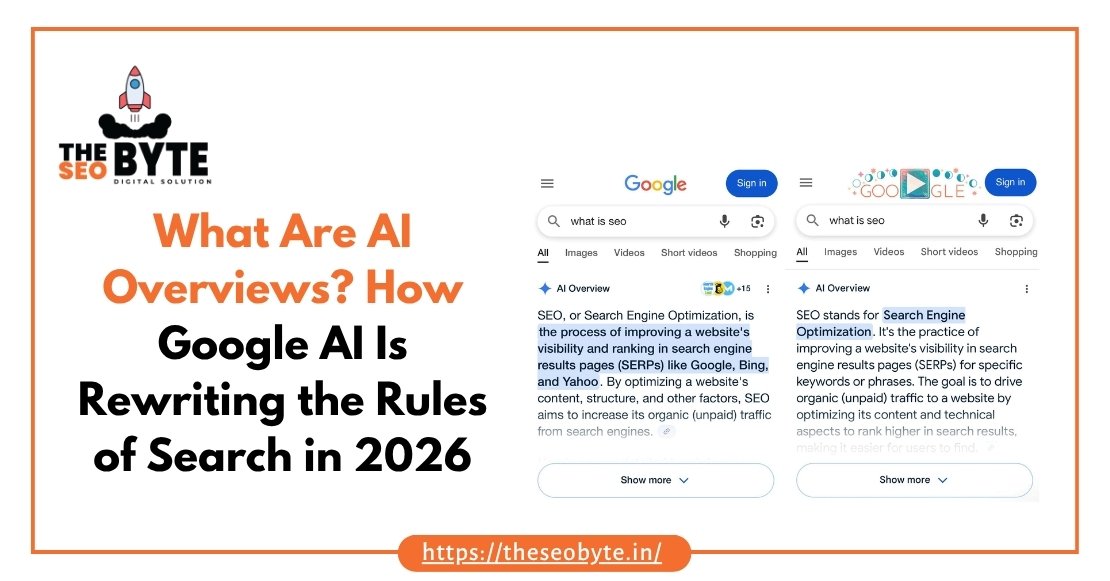
If you’ve searched on Google recently and noticed a big AI-generated answer box sitting right at the top of the page before the ads, before the blue links, before everything, you’ve already encountered Google AI Overviews. And whether you’re a brand marketer, an SEO professional, or a business owner trying to stay visible online, understanding what AI Overviews are and how they work is no longer optional. It’s survival.
This guide breaks down everything you need to know about what is AI Overview, how they’re changing organic search, and most importantly what your brand needs to do right now to stay relevant in an AI-first search world.
What Are AI Overviews? The Simple Answer
Let’s start at the beginning. What are AI Overviews?
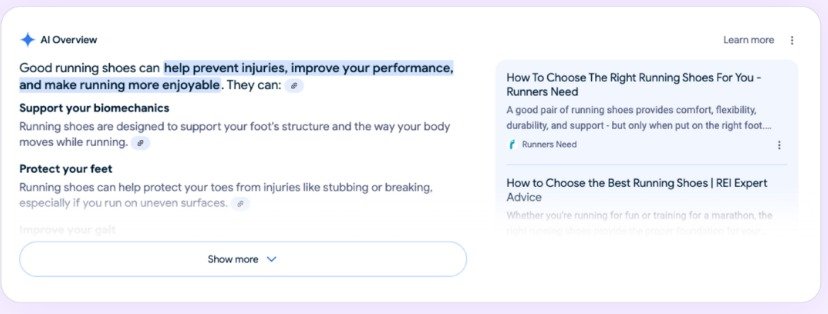
Google AI Overviews (formerly known as Search Generative Experience or SGE) are AI-generated summary responses that appear at the very top of Google’s search results page in what’s commonly called “position zero.” When a user searches for something, Google’s AI doesn’t just pull a snippet from a webpage anymore. It synthesizes an answer using its own AI-powered overview, pulling context from multiple sources and presenting a comprehensive, conversational response directly in the SERP.
Think of it as Google becoming the answerer, not just the finder.
What is Google AI Overview at its core? It’s Google’s way of keeping users on Google longer, answering their questions so thoroughly within the search results that clicking through to websites becomes optional. For searchers, it’s incredibly convenient. For businesses that rely on organic traffic? It’s a seismic shift that demands a new approach to content and SEO strategy.
When Did AI Overview Come Out?
Understanding the timeline helps put the current landscape in context.
Google first introduced the concept in May 2023 at Google I/O, under the name Search Generative Experience (SGE). It was rolled out as an opt-in experimental feature in Google Labs meaning only users who signed up could see it.
Then, in May 2024, everything changed. Google rebranded SGE as Google AI Overviews and made it a live, default feature in US search results—no opt-in required. Suddenly, hundreds of millions of searches were being answered by AI before a single organic result was shown. A broader global rollout followed throughout late 2024 and into 2025.
So when did AI Overview come out officially? May 2024 — and the search world hasn’t been the same since.
How Does AI Overview Work? The Technical Breakdown
This is where it gets interesting. How does AI Overview work under the hood?
At its core, Google AI relies on Gemini — Google’s large language model (LLM) — to generate these AI-powered overviews. Unlike traditional search, which retrieves and ranks existing documents, Gemini synthesizes new text based on patterns it learned during training. It doesn’t copy-paste from a webpage; it generates a new, contextual answer.
But here’s what makes Google AI unique compared to something like ChatGPT: Google doesn’t rely on the LLM alone. Because LLMs have training cutoffs and can’t link to original sources directly, Google AI Overviews are paired with cited source links pulled from Google’s traditional organic search index. The same index powers the classic “ten blue links.”
So how does Google AI Overview work in practice? Here’s the step-by-step:
- You type a query into Google Search.
- Google’s AI (Gemini) processes the intent behind your query and generates a synthesized summary answer.
- Google’s organic index is consulted in parallel to find the top-ranking pages that match the generated content.
- The AI Overview appears at the top of the SERP with the generated text, source citations, and expandable “Show More” sections.
- Users can click any of the cited sources to dive deeper, or they can get everything they need directly from the AI overview itself.
How do AI Overviews work differently from Featured Snippets? While a featured snippet lifts exact text from a single webpage, an AI overview search result is freshly generated each time — synthesized, multi-source, and often much longer than any snippet. It’s a fundamentally different beast.
The Four Main Components of a Google AI Overview
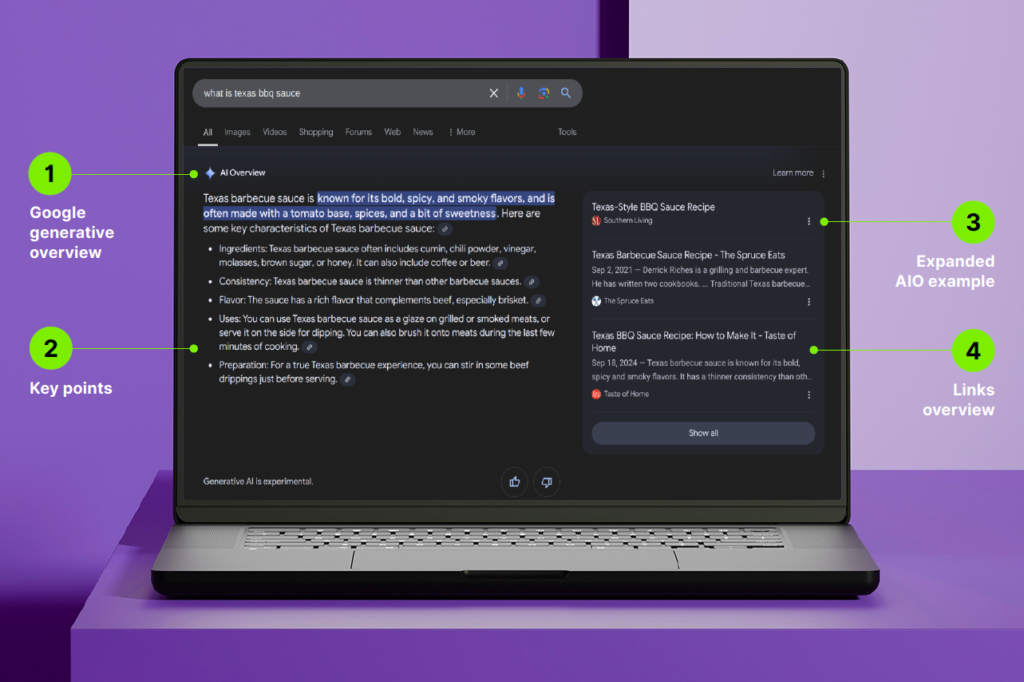
If you want to appear in — or understand — an AI overview search result, you need to know what you’re looking at. Every Google AI Overview has four core components:
1. The Generative Summary: This is the AI-written response itself. It’s often hidden in a collapsed state, and users click to expand it. The text is generated fresh by Gemini, not pulled verbatim from any one source.
2. Key Points with Links: Below the main summary, you’ll usually see a bulleted list of key ideas, each hyperlinked to a source website. These links are added after the AI generates its text — Google matches them to the most relevant indexed pages.
3. The Expanded Answer: Users can click “Show More” to reveal a fuller, more detailed AI-generated response for complex queries. This is where AI-powered overview content gets truly deep.
4. Linked Source Carousel: A visual carousel of source websites that back up the AI-generated content. Users can click “Show All” to see up to 12 sources. Importantly, AI overviews and sources’ research show that most of these links come from pages already ranking in the top 35 organic positions.
AI Overview vs Featured Snippets: Key Differences
A question that comes up constantly in SEO circles is AI Overview vs
Featured Snippets — what’s the real difference?
| Feature | Featured Snippet | AI Overview |
| Source | One webpage | Multiple sources synthesized |
| Content type | Exact text extraction | AI-generated new text |
| Length | Short paragraph or list | Often multi-paragraph |
| Citations | One URL | Multiple URLs |
| Frequency | ~8% of queries | ~59% of informational queries |
| Technology | Index-based retrieval | LLM-based generation |
The AI overview vs. featured snippets comparison makes one thing clear: what are AI Overviews is not just an evolution of featured snippets. It’s a completely different mechanism — one that requires a completely different optimization strategy.
Why Google AI Overviews Matter for Your Business
Here’s the business reality behind what an AI overview for brands is:
AI Overviews now appear for approximately 59% of informational searches and 19% of commercial intent searches. That means more than half of all informational queries on Google are now answered — at least partially — before a user ever sees an organic link.
Google AI still commands roughly 90% of the global search engine market share. That’s not changing anytime soon. So the impact of Google AI Overviews on organic traffic isn’t hypothetical; it’s happening right now to every website that depends on Google for visibility.
The stakes are clear:
- Reduced click-through rates for informational content that used to drive top-of-funnel traffic
- Increased importance of commercial and transactional content (AI Overviews appear less often for purchase-intent queries)
- New opportunities for brands cited as sources within the AI overview search results citation = visibility without even ranking #1
- Brand authority signals become more critical, as Google’s AI favors trustworthy, authoritative sources.
For marketers, what Google AI Overview translates to is a new search surface you must optimize for, not just observe.
AI Overviews Sources Research: What Content Gets Cited?
This is the question every SEO and content marketer should be asking: What does AI overview sources’ research tell us about what gets cited?
The data is clear. Brands and pages that get cited in Google AI Overviews tend to share these characteristics:
1. Strong Organic Rankings: Studies consistently show that most sources cited in AI overview search results are already ranking in positions 1–12 organically. The AI doesn’t discover hidden gems — it amplifies what’s already ranking well. Your SEO foundation must be solid before you can earn AI Overview citations.
2. Clear, Structured Content: How does AI overview work when deciding what to cite? It looks for content that directly answers the user’s question, clearly structured with headings, bullet points, definitions, and logical flow. Content that “sounds like an answer” gets cited more.
3. Topical Authority Pages from websites that consistently cover a subject deeply — not just one blog post, but an entire content ecosystem around a topic — are more likely to be included. This is why AI-powered overview citations tend to cluster around recognized industry publishers.
4. E-E-A-T Signals: Experience, Expertise, Authoritativeness, and Trustworthiness — Google’s long-standing content quality framework — directly influence Google AI citation decisions. Author bios, citations, data references, and reputable backlinks all matter.
5. Conversational & Question-Answering Format Content written to answer questions — not just describe topics — performs better in AI overview search. Think “What is X?” “How does Y work?” and “Why does Z happen?” framing throughout your content.
How Does Google AI Overview Work for Marketing Content Specifically?
If you’re in marketing, how does Google AI overview work for your content strategy?
The shift is profound. Traditional SEO was about ranking in the top 10 blue links. Now, what AI Overviews for marketers means there’s a new tier of visibility above the traditional rankings — and a new risk of your traffic being absorbed by the AI itself.
Here’s how to think about it:
Content that was “good for SEO” before may not be “good for AI Overview citation.” Thin, keyword-stuffed content won’t get cited. Long-form, authoritative, genuinely helpful content will.
Answer Engine Optimization (AEO) is becoming as important as traditional SEO. AEO focuses on structuring content so AI systems — not just search engine crawlers — can extract and present your answers confidently. If you’re not already thinking about AEO, you’re already behind.
Brand mentions in AI Overviews build trust at scale. Even if a user doesn’t click your link, seeing your brand cited in a Google AI Overview positions you as an authority in your niche. This is a new form of brand visibility that didn’t exist three years ago.
How to Get Your Brand Into Google AI Overviews
Now for the actionable part. If what AI Overviews are is the “what,” this section is the “so what.” Here’s how to optimize for Google AI Overviews:
1. Fix Your SEO Foundation First
Since most AI overview search citations come from pages already in the top 35 organic positions, your technical SEO, site speed, crawlability, and backlink profile must be strong. If Google can’t find, crawl, and index your content, it won’t cite you.
2. Create Genuinely Comprehensive Content
What is AI overview looking for? Depth. Write content that covers a topic completely — not 500 words, but 2,000+ words with subtopics, examples, data, and clear structure. The more thoroughly you answer a question, the more likely your content is to be synthesized into a Google AI Overview.
3. Use Clear Question-and-Answer Structure
Use H2 and H3 headings that are phrased as questions. Then answer them immediately and clearly beneath each heading. This structure maps directly to how an AI overview works when pulling cited sources.
4. Add Structured Data Markup
Schema markup particularly FAQ schema, HowTo schema, and Article schema, helps Google’s AI understand and categorize your content. It’s one of the clearest signals you can send about what your content answers.
5. Build Topical Authority Clusters
Don’t publish one article. Build a content cluster around your core topics. If you’re a digital marketing agency in Agra, for example, publish interconnected content about SEO, AI search, content marketing, and local search, each piece reinforcing the others.
6. Optimize for Conversational Queries
How do AI overviews work in relation to voice and conversational search? They’re deeply connected. As Google’s AI becomes more conversational, content written in a natural, question-answering style performs better. Write the way people talk, not the way press releases read.
7. Earn Quality Backlinks
Backlinks remain a strong signal of authority. The more authoritative sites that link to your content, the more likely Google AI is to trust and cite it. Focus on earning links from industry publications, local business directories, and reputable niche websites.
Best Google AI Overview Checking Tool: How to Monitor Your Visibility
Knowing whether your content appears in Google AI Overviews is critical for measuring your AEO and SEO performance. The best Google AI overview checking tool options include the following:
1. Botify: Enterprise-grade platform specifically tracking AI Overview visibility, citations, and organic performance side-by-side. One of the best Google AI overview-checking tool options for large brands.
2. SE Ranking: Tracks AI Overview appearance for your tracked keywords and monitors whether your domain is cited.
3. Semrush AI Overview Tracker: Semrush has integrated AI Overview monitoring into its keyword tracking suite, showing which of your target keywords trigger an AI Overview and whether you appear in it.
4. BrightEdge: An AI-powered overview analyzer that maps content performance across traditional and AI search surfaces simultaneously.
5. Ahrefs: Updated SERP feature tracking to flag keywords where AI Overviews appear, helping you prioritize which queries to target.
Using an AI overview analyzer consistently is critical. You can’t optimize what you don’t measure, and Google AI Overview visibility is its own metric now — separate from, but connected to, traditional organic rankings.
AEO vs SEO: Understanding the New Search Landscape
Here’s a question every marketer should sit with: Is AEO vs SEO a competition, or are they complementary?
The honest answer: they’re complementary, but they require different content decisions. (Read our full breakdown of AEO vs SEO to go deeper on this topic.)
Traditional SEO focuses on ranking signals, backlinks, technical performance, and keyword optimization to appear in the ten blue links. Answer Engine Optimization (AEO) focuses on structuring content so AI systems (Google’s AI, ChatGPT, Perplexity, etc.) confidently extract and present your answers.
The brands that win in 2025 and beyond will do both. SEO gets your pages into the index and into the top positions. AEO gets those pages cited in AI-generated responses that now dominate the SERP’s prime real estate.
The SEO Byte’s Approach to AI Search Optimization
At The SEO Byte, we’ve been tracking the evolution of Google AI Overviews since the SGE beta days. Our team has developed a proven methodology for helping brands stay visible in an AI-first search environment combining traditional SEO excellence with cutting-edge AI SEO services.
Whether you’re a local business in Agra trying to compete in a changing search landscape or an enterprise brand watching your organic traffic metrics shift, we build strategies that work for both search engines and AI systems.
Our services include:
- AI Overview visibility audits: We analyze which of your target queries now trigger Google AI Overviews and whether your content is positioned to be cited.
- Content architecture & AEO strategy: We restructure and create content specifically optimized for AI overview search citation.
- Technical SEO: Ensuring your site is crawlable, fast, and indexed the non-negotiable foundation for any AI visibility strategy.
- Local AI search optimization: Helping businesses in Agra and across India earn visibility in local AI-generated search results.
As a leading SEO company in Agra, we combine local market expertise with global AI search knowledge to give our clients an edge no algorithm update can easily take away.
Looking for a digital marketing agency in Agra that actually understands AI search? Our team is ready to help you adapt and grow. (See our full range of AI SEO services in Agra.)
Frequently Asked Questions About Google AI Overviews
Q: What are AI Overviews in simple terms?
A: What are AI Overviews? They’re AI-generated summary answers that appear at the very top of Google search results, above all organic links and ads. Google’s AI reads, synthesizes, and summarizes information from multiple sources to answer your query directly on the search page.
Q: What is AI Overview and how is it different from regular search results?
A: What is AI overview vs regular results? Regular results show a list of ranked web pages. An AI Overview generates a fresh, synthesized answer using Google’s Gemini AI, accompanied by source citations. It’s faster for users but changes how brands earn visibility.
Q: How does AI overview work for my website’s traffic?
A: How does AI overview work on your traffic? If your content is cited as a source, you may receive referral visits. However, if your content answers questions that are now answered directly in AI Overviews, your informational content may see lower click-through rates. This is why optimizing for citation — not just ranking — is critical.
Q: How do AI Overviews work for commercial queries?
A: How do AI Overviews work for purchase-intent searches? Less aggressively than for informational queries. AI Overviews appear for about 19% of commercial searches — meaning product pages, service pages, and transactional content are somewhat more protected from the “zero-click” effect.
Q: What is Google AI Overview doing to SEO?
A: What is Google AI overview doing to the SEO profession? It’s expanding it. Traditional SEO remains essential (you can’t be cited if you don’t rank), but it now needs to be paired with AEO — optimizing for AI citation and answer engine visibility.
Q: When did AI Overview come out and why does it matter?
A: When did AI Overview come out? Officially, May 2024 in the US. It matters because it fundamentally changed how Google surfaces information — making AI the first answerer and organic links the secondary resource.
Q: What is Google AI and is it the same as Google AI Overview?
A: Google AI broadly refers to Google’s suite of AI tools and models (Gemini, Bard, etc.). What are AI Overviews specifically? They are one product built on Google’s AI infrastructure — the SERP feature that displays AI-generated answers in search results.
Q: How can I check if my content appears in AI Overviews?
A: Use an ai overviews analyzer or the best Google AI overview checking tool available to you — options like SE Ranking, Semrush, Botify, or BrightEdge all offer AI Overview tracking. You can also manually search your target queries and check whether your domain appears in the cited sources section.
Q: Does Google AI Overview affect local businesses?
A: Yes — and significantly. As Google AI becomes more capable of answering local queries (“best digital marketing agency in Agra,” “top SEO services near me”), local businesses need both strong local SEO and AEO foundations to appear in AI-generated local answers.
Q: What is the relationship between AI Overviews and Answer Engine Optimization?
A: Answer Engine Optimization (AEO) is the practice of structuring content so AI systems — including Google AI Overviews — can confidently extract and present your answers. It’s the strategic response to the rise of what are AI Overviews as a dominant search surface. (Explore our Answer Engine Optimization services.)
The Future of Search Is Already Here
What are AI Overviews today is what search will be, entirely, tomorrow. Google is investing billions in making its AI-powered overview capabilities more accurate, more conversational, and more deeply integrated into every search interaction.
The brands that wait to adapt will find themselves invisible — not because they did anything wrong, but because the landscape moved on without them. The brands that move now — building authoritative content, earning AI citations, and working with experts who understand both traditional SEO and the new Google AI Overview ecosystem — will be the ones who dominate search in the years ahead.
Ready to Win in the Age of AI Search?
At The SEO Byte, we specialize in helping businesses like yours stay visible, competitive, and profitable as Google’s AI rewrites the rules of search.
Here’s what we can do for you:
✅ Full Google AI Overviews visibility audit for your brand
✅ AEO content strategy designed to earn AI citations
✅ Technical SEO that gets your pages indexed and ranked
✅ Local AI search optimization for businesses in Agra and beyond
✅ Ongoing AI SEO services that evolve as Google’s AI does
Don’t let your competitors claim the AI Overview citations your brand deserves.
📞 Contact The SEO Byte today — your free AI search audit is one conversation away.
Get Your Free AI Search Audit →
The SEO Byte is a leading digital marketing agency in Agra, offering specialized AI SEO services in Agra and nationwide. We help brands navigate the evolving search landscape — from traditional organic rankings to AI Overview citations and beyond.

1 Comment